
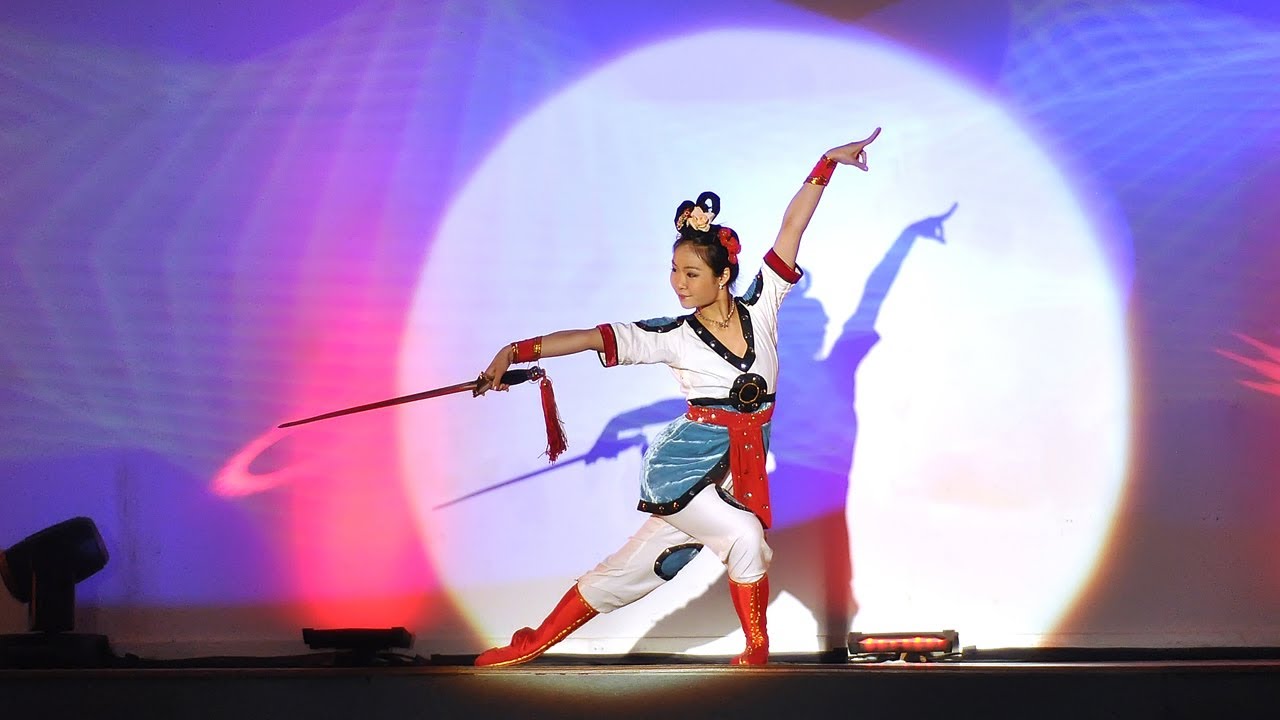
Chinese Martial Arts Choreography and Classical Dance
Balletic fighting is part of the Chinese love of action, cinema and spectacle. Kung fu masters flash fists and feet of fury, spinning through the air to vanquish their opponents. These nature-inspired moves (“the butterfly,” “the lotus kick,” “the tornado”), are performed in Chinese classical dance too.
Superficially classical Chinese dance and martial arts (kung fu or wushu, in Chinese) share some similarities. They have overlapping stances and postures, and their techniques require flexibility, coordination, and agility. Quite often traditional weapons—sticks, spears, swords and the like—are used in both martial arts and Chinese dance. Why? Because these two art forms are rooted in the same ancient culture.
When wushu first appeared in China thousands of years ago, its flips and techniques greatly influenced other art forms, including Chinese opera and dance. These art forms took movements originally intended for battle and transformed them into a means of entertainment for various celebrations—from casual festivities to imperial banquets. Over time, martial arts and classical Chinese dance grew into the comprehensive and separate art forms we know today.
But although these are distinct art forms, classical Chinese dance and martial arts can sometimes pass as look-alikes. Then, how can you tell these ancient disciplines apart?
Kung fu is about fighting – vanquishing an opponent, so uses pared-down techniques, rather than flamboyant style – it’s no good being grandiose if it gets you beaten to the ground, whereas Chinese classical dance is an expression of many things, and so is more expansive.
In classical Chinese dance, performers need to show the aesthetic process of each movement. By moving too fast the audience won’t be able enjoy the details of the physical expression. Sometimes, to portray an emotion, what’s needed is a long, slowly drawn out move that ends in a near pause mid-air before continuing in the opposite direction. These moves, though subtle, seem to almost burst with restraint.
So the two similar disciplines have moved to opposite poles – one swift and brutal, the other expansive and reflective. Chinese classical dance is about happiness, beauty, compassion, peace, and harmony which is a long way from fighting.